
Pike County Court Overview
Pike County is Pennsylvania's 60th Judicial District. The county court site describes the court as one of 60 separate judicial districts within Pennsylvania's unified judicial system. The Court of Common Pleas has President Judge Gregory H. Chelak and Judge Kelly A. Gaughan. Court Administration is responsible for day-to-day operations of the Pike County judicial system, including case assignments, scheduling, jury selection, statistical reporting, and information coordination.
Court Administration is at 412 Broad Street, Suite 4, Milford, PA 18337, phone 570-296-3556, with office hours Monday through Friday, 8:30 a.m. to 4:30 p.m. The Pennsylvania Courts county page lists Pike County Courthouse, 410 Broad Street, Milford, PA 18337, phone 570-296-7231, and fax 570-296-6054. The county court materials use 412 Broad Street for operating court offices.
Pike County Court Administration
412 Broad Street, Suite 4
Milford, PA 18337
570-296-3556
Monday-Friday, 8:30 a.m.-4:30 p.m.
Pike County Court and MDJ Table
Pike County has one Court of Common Pleas judicial district and four Magisterial District Courts. The MDJ courts are not branches of the Prothonotary or Clerk of Courts. They are lower courts with geographic jurisdiction over specific boroughs and townships. They handle many first-contact court events, especially traffic citations, summary criminal cases, landlord-tenant cases, small civil claims, preliminary arraignments, preliminary hearings, and emergency PFA proceedings when Common Pleas is not in session.
| Court | Judge | Address | Phone | Jurisdiction or Role |
|---|---|---|---|---|
| Court of Common Pleas, 60th Judicial District | Gregory H. Chelak, President Judge; Kelly A. Gaughan, Judge | 412 Broad Street, Milford, PA 18337 | 570-296-3556 | County trial court for Common Pleas civil, family, criminal, and related matters |
| MDJ 60-3-01 | Cristin Cavallaro | 102 East John Street, Milford, PA 18337 | 570-296-8108 | Milford and Westfall Townships; Matamoras and Milford Boroughs |
| MDJ 60-3-02 | Randy Schmalzle, Esq. | 106 Shook Road, Suite 100, Hawley, PA 18428 | 570-226-9650 | Blooming Grove, Greene, and Palmyra Townships |
| MDJ 60-3-03 | Ashley Zimmerman | 502 Little Walker Road, Shohola, PA 18458 | 570-296-7726 | Dingman, Lackawaxen, and Shohola Townships |
| MDJ 60-3-04 | Christina Ballas | 213 Silver Lake Road, Dingmans Ferry, PA 18328 | 570-828-2880 | Delaware, Lehman, and Porter Townships |
Pike County Magisterial District Courts
The four Pike County Magisterial District Courts each publish judge, address, phone, municipal jurisdiction, and hours. The research lists each MDJ office as open Monday through Friday, 9 a.m. to 3 p.m. Local Rule 117 states that each Magisterial District Court is open during regular business hours and that MDJs provide continuous coverage for warrant issuance, preliminary arraignments, and setting and accepting bail.
The MDJ 60-3-01 page identifies the Milford-area district court serving Milford and Westfall Townships plus Matamoras and Milford Boroughs.
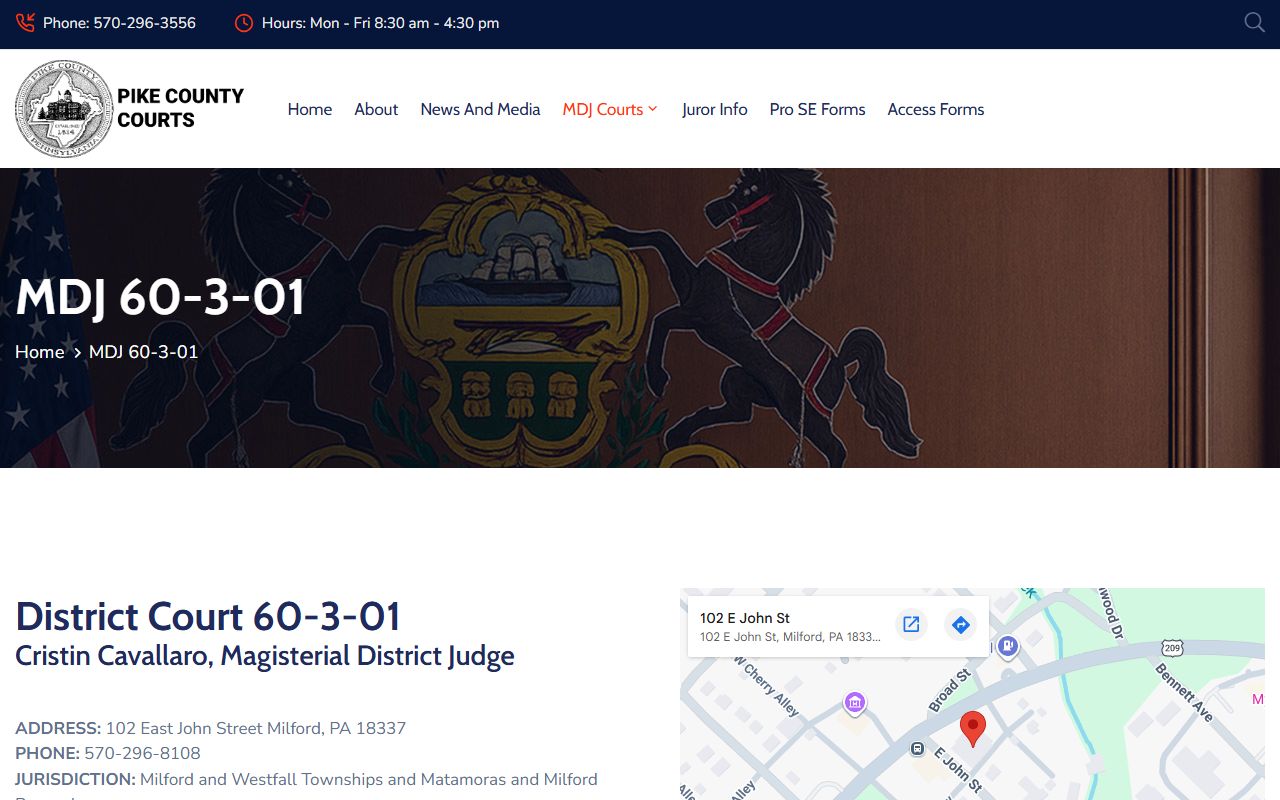
That MDJ court is a common first stop for local traffic, summary, landlord-tenant, small civil, and preliminary criminal matters tied to its municipalities.
The MDJ 60-3-02 page identifies the Hawley-area district court serving Blooming Grove, Greene, and Palmyra Townships.
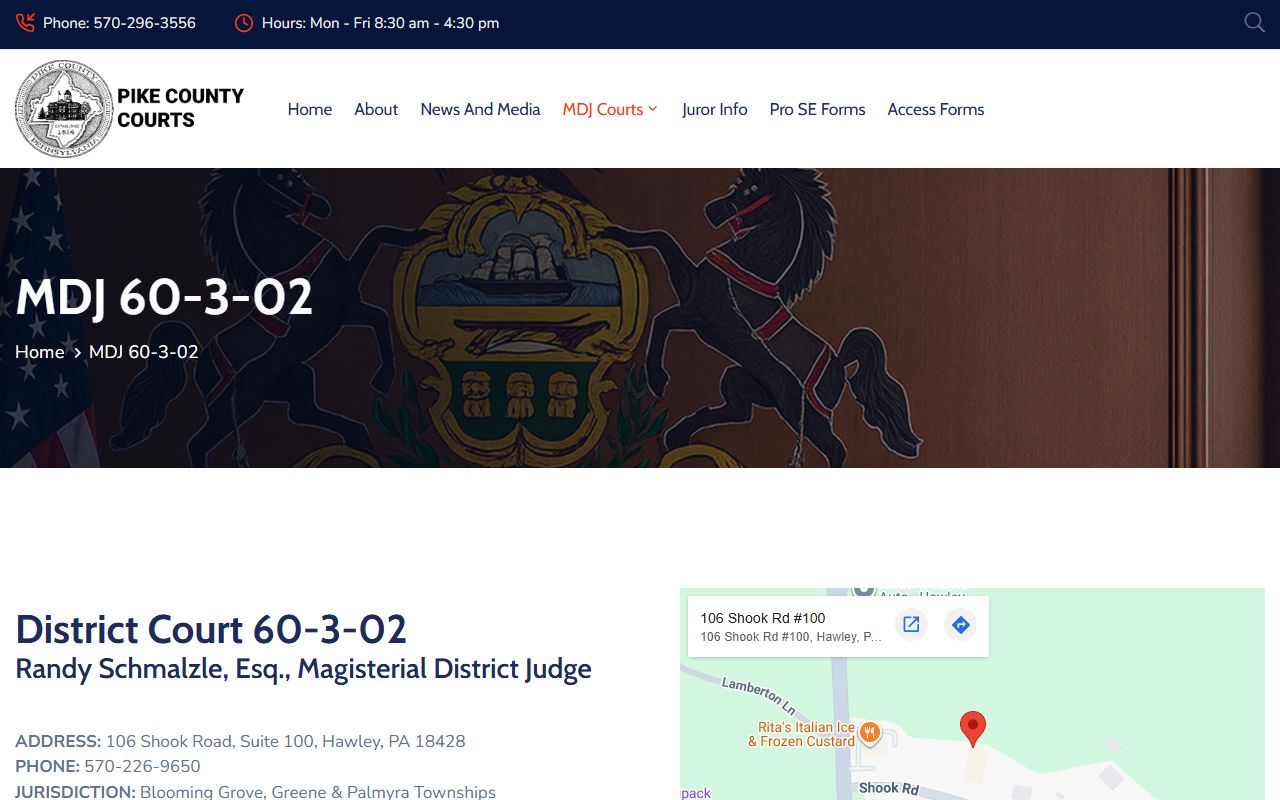
Use that district when the citation, complaint, or landlord-tenant property is tied to those Pike County townships.
The MDJ 60-3-03 page identifies the Shohola district court serving Dingman, Lackawaxen, and Shohola Townships.
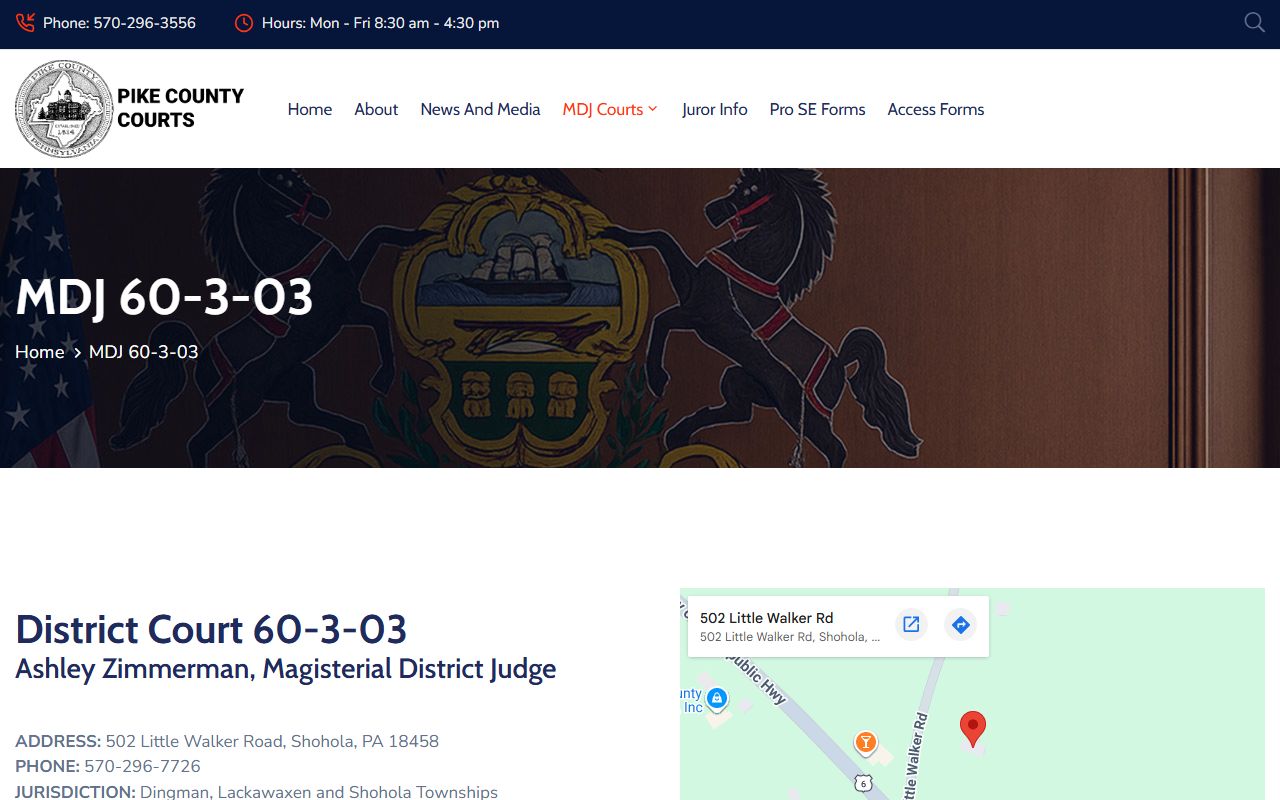
The municipal split matters because MDJ dockets and hearing notices follow the issuing district rather than the courthouse address alone.
The MDJ 60-3-04 page identifies the Dingmans Ferry district court serving Delaware, Lehman, and Porter Townships.
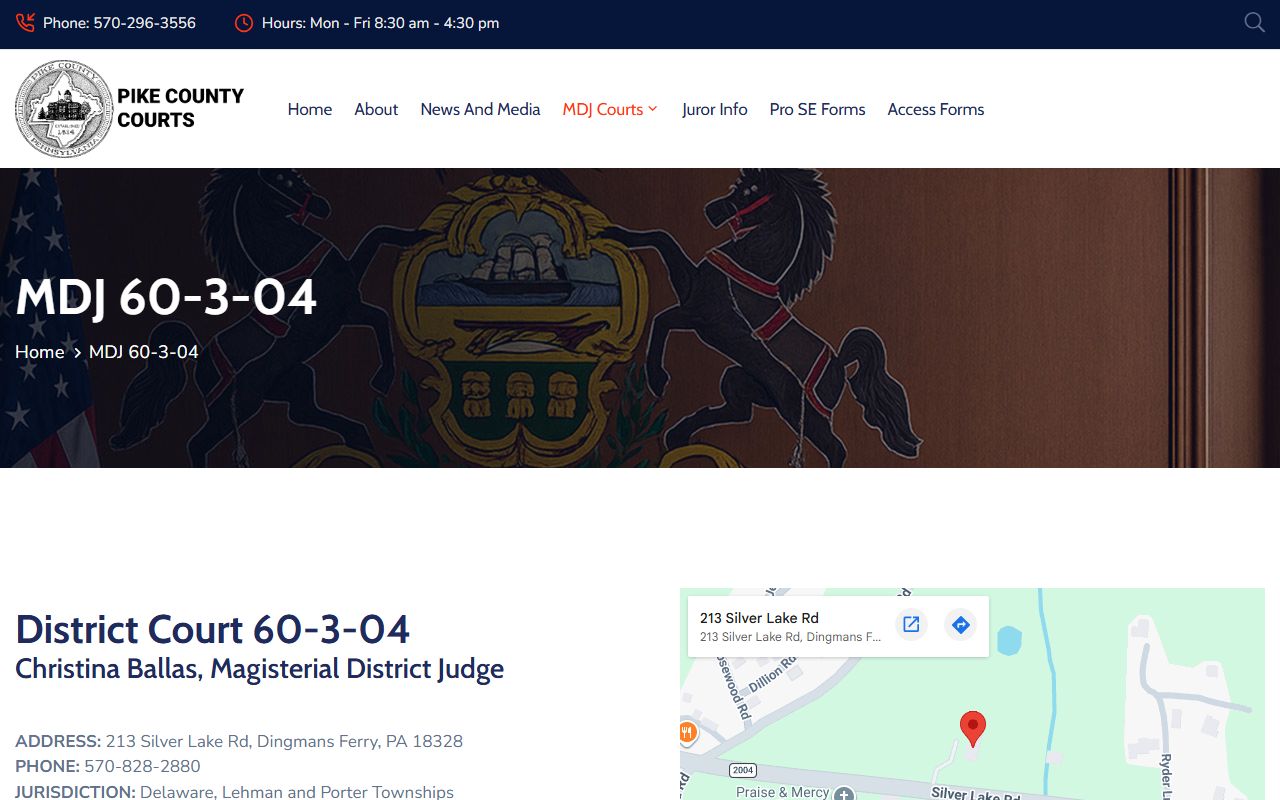
That office is the lower-court contact for qualifying local cases from the Delaware, Lehman, and Porter Township area.
Pike County Common Pleas vs MDJ
Pennsylvania does not use a county court versus justice court model in Pike County. The practical comparison is Court of Common Pleas versus Magisterial District Court. The Court of Common Pleas is the county trial court. The MDJ courts handle lower-level matters and the early stages of many adult misdemeanor and felony criminal cases before they move to Common Pleas.
| Feature | Court of Common Pleas | Magisterial District Court |
|---|---|---|
| Civil jurisdiction | Common Pleas civil actions, equity, family, divorce, custody, PFA, judgments, and appeals from lower tribunals | Civil money cases not exceeding $12,000 and landlord-tenant nonpayment and eviction complaints |
| Criminal jurisdiction | Common Pleas criminal cases after lower-court proceedings, motions, pleas, trials, sentencing, and appeals | Summary criminal offenses, preliminary arraignments, preliminary hearings, bail, and early adult misdemeanor or felony stages |
| Traffic role | DUI and other criminal traffic cases may proceed here after MDJ stages | Minor traffic offenses and many citation-level matters begin here |
| Emergency PFA | Regular Common Pleas PFA matters | Emergency PFA proceedings when Common Pleas is not in session |
| Record custodian | Prothonotary for civil records and Clerk of Courts for criminal records | Issuing MDJ court, with docket information also available through UJS where public |
Pike County Case Flow
Pike County case flow depends on the type of filing. A small civil claim or landlord-tenant case may stay in the Magisterial District Court unless appealed. A civil complaint, divorce, custody action, PFA filing, judgment, or lien is handled through Common Pleas civil filing channels and the Prothonotary. Criminal cases often start at the MDJ level, then move to Common Pleas when charges are held for court.
Criminal case flow: Police complaint or arrest › MDJ preliminary arraignment and bail › MDJ preliminary hearing › Common Pleas criminal docket › motions and plea or trial › disposition and sentence › appeal when filed.
Civil case flow: Complaint or petition filed with the Prothonotary › service and response › motions, conferences, or hearings › order, settlement, trial, or judgment › post-trial or appellate steps when filed.
Lower-court civil flow: MDJ complaint › hearing or judgment › payment, possession, satisfaction, or appeal to Common Pleas.
Pike County Court Records Access
The statewide UJS Case Search is the main free online court-record channel for Pike County. It covers Pennsylvania appellate, Common Pleas, Magisterial District, and Philadelphia Municipal Court records. Pike County Court of Common Pleas appears in the court dropdown list. PAeDocket is also available as a free statewide mobile app and supports searches by case number, participant name, organization name, offense tracking number, police incident or complaint number, and state ID number.
Online dockets do not replace the record custodian. The Pike County Prothonotary handles civil Common Pleas files, including divorce, custody, PFA, judgments, name changes, appeals, and liens. The Clerk of Courts handles criminal Common Pleas records and summary appeals. The Clerk of Orphans' Court handles guardianship, adoption, incapacity, and marriage-license work, while the Register of Wills handles probate estates and inheritance tax.
Note: UJS warns that recent filing-office entries may not appear on docket sheets right away.
Pike County Court Filing Rules
Pike County local rules give practical filing details for paper filings. Paper filings must be clearly legible, single-sided, on 8.5 by 11 inch white paper, secured by metal fastener, and exhibits must be tabbed and labeled. Facsimiles are not accepted as original filings unless Court Administration gives specific permission. These are filing rules rather than building-entry rules, but they matter when a person is trying to place a paper document into the court record.
The ADA accommodation process is handled through the court's ADA form and policy. The form asks for case number, court division, judge or Magisterial District Judge, proceeding date, time, location, and requested accommodation. It is sent to Samantha G. Venditti, District Court Administrator and ADA Coordinator. The ADA addendum also states that the 60th Judicial District does not impose blanket bans on lawfully prescribed medication for substance-use-disorder treatment in court supervision or problem-solving court contexts.
Pike County Appeals and Limits
Appeals and transfers depend on where the case began. MDJ civil judgments, landlord-tenant matters, summary convictions, and District Justice appeals can move into Common Pleas channels when a party files the proper appeal. The Prothonotary fee schedule lists District Judge, PennDOT, zoning, and assessment appeals at $142. The Clerk of Courts fee schedule lists summary conviction appeals after November 12, 2025 at $56.50.
Common Pleas appeals to a Pennsylvania appellate court have a separate fee structure. The Prothonotary schedule lists an appeal from Common Pleas to appellate court at $44.25 plus a separate appellate check of $91.25. The Clerk of Orphans' Court fee schedule lists appeal at $62 plus an appellate check of $91.25. Use the office tied to the record type before filing because civil, criminal, and Orphans' Court appeal costs are not the same.
The court office also connects to courthouse access questions. Court Administration is the contact named by the court site when users cannot find needed information, and the ADA process is routed through the District Court Administrator. That makes Court Administration the operational contact for scheduling, jury, accommodation, and court-management questions, while the Prothonotary and Clerk of Courts remain the records custodians for filed documents.