
Pike County Arrest Records and Court Charges
Pike County arrest records are tied to law-enforcement and custody events. They may connect to an arresting agency, booking or jail contact, an arrest warrant, or an early MDJ proceeding. The official county correctional page does not publish a public jail roster search form, so custody questions use the Pike County Correctional Facility, VINE, ICE ODLS for immigration detainees, or the Pennsylvania DOC locator for state-sentenced inmates and parolees. Jail custody details belong with inmate records, not with the court charge record.
The court charge record begins when criminal allegations enter the court system. In Pike County, Local Rule 507 is important: the District Attorney's filed certification requires approval by an Attorney for the Commonwealth before filing a criminal complaint and arrest-warrant affidavits. After charges are filed, the docket can show the complaint, statute sections, grading, offense tracking number, police incident or complaint number, arresting agency, preliminary arraignment, bail, preliminary hearing, disposition, sentencing, and later case events. For the full case file and outcome, use Pike County criminal court records.
The U.S. Attorney for the Middle District of Pennsylvania is an assigned source for Pike County arrest and charge records when a matter is federal rather than local.
Most Pike County charges are state or local matters, but federal charges use federal prosecutors and federal court records instead of the county criminal docket.
Find Pike County Arrest Records and Charges
To find court charges after arrest, start with UJS Case Search and search Pike County criminal or Magisterial District Court dockets. Use a defendant name, docket number, offense tracking number, police incident or complaint number, or state ID number if known. PAeDocket, described by the UJS portal, supports several of the same search paths from a mobile device.
- Identify whether the matter is still in an MDJ court or has moved to the Pike County Court of Common Pleas.
- Search UJS by defendant name, docket number, or criminal identifier and limit results to Pike County where possible.
- Open the docket and read the charge list, statute section, grade, filing date, court, and current status.
- Check the docket entries for preliminary arraignment, bail, preliminary hearing, bench warrant, disposition, and sentencing events.
- Contact the Clerk of Courts for certified case documents, or use PATCH if an official statewide criminal-history check is required.
If the person is in custody, Pike County Correctional Facility information is separate from the charge record. The county correctional page points users to the facility phone, VINE, ICE locator, and Access Corrections links rather than a local public roster form.
Pike County Charging Documents
A charging document is the paper or filing that tells the court what crime is alleged. The Pike County research identifies the criminal complaint and arrest-warrant affidavit as the local filings that need Commonwealth attorney approval under Local Rule 507. Pennsylvania criminal practice can also involve an information in Common Pleas after charges are held for court. Federal indictments belong to federal court, not the Pike County Clerk of Courts.
| Document | Where It Fits | Pike County Access Point | What to Read |
|---|---|---|---|
| Criminal complaint | Starts or states the criminal allegations in court | MDJ or Clerk of Courts docket depending on stage | Counts, statute sections, grading, complaint number, and arresting agency |
| Information | Common Pleas charging document after a case moves forward | Pike County Clerk of Courts | Formal charges to be answered in Common Pleas |
| Indictment | Federal or grand-jury charging route when applicable | Federal court, not the county filing office | Federal counts, case number, prosecutor, and court |
Pike County Charge Status Terms
Charge status changes as a case moves. A docket can show a charge before the final outcome, so the status must be read with the latest docket entries. One arrest can produce several charges, and each count can have a different outcome. A charge can be held for court, amended, reduced, dismissed, withdrawn, or result in a plea or verdict. The disposition and sentencing entries tell more than the first charge line.
| Status | What It Means | Where to Confirm |
|---|---|---|
| Pending | The charge is open and has not reached final disposition. | Latest UJS docket entries and hearing schedule. |
| Held for court | The charge moved forward after the preliminary stage. | MDJ docket and Common Pleas criminal docket. |
| Amended or reduced | The charge changed from the original count or grade. | Charge list, docket entries, and formal information. |
| Dismissed or withdrawn | The count did not continue as filed. | Disposition entry for that specific count. |
| Nolle prosequi | The Commonwealth declined to continue a charge. | Court order or docket disposition where entered. |
| Guilty plea or verdict | The charge ended in a conviction event. | Disposition and sentencing entries. |
Pike County Charges vs Convictions
A charge is not the same as a conviction. Arrest records and early court charges show accusations and process steps. Convictions appear only after a guilty plea, guilty verdict, or other qualifying final outcome. Because a Pike County docket may list charges that were later reduced, dismissed, or withdrawn, each count should be checked against the disposition date, final plea or verdict, and sentence.
| Question | Charge | Conviction |
|---|---|---|
| What is it? | An accusation filed in court after arrest or investigation | A final guilty outcome on a charge |
| When does it appear? | Early in the docket or charging document | At disposition and sentencing |
| Can it change? | Yes, it may be amended, reduced, dismissed, or withdrawn | It may be affected by appeal, expungement, or limited access |
| How should it be used? | As an allegation unless final outcome confirms more | With sentence, date, court, and later docket activity |
Sealed and Expunged Charge Records
Some Pike County arrest records and court charges are not public. Juvenile and dependency cases are not viewable through public UJS according to the Clerk of Courts page. Sealed filings, confidential records, protected identifiers, and expunged or limited-access records require legal authority to view. Pennsylvania's UJS policy also restricts remote access to Social Security numbers, financial account numbers, driver's license numbers, state identification numbers, most minors' names and dates of birth, and abuse-victim address or contact data.
| Feature | Sealed / Limited Access | Expunged |
|---|---|---|
| Public view | Hidden or restricted from normal public access | Removed or destroyed from public access when granted |
| Common reason | Confidential filing, protected person, or limited-access order | Qualifying adult or juvenile expungement order |
| Pike fee source | Depends on petition and record type | Adult expungement listed at $178 after November 12, 2025 |
| Where filed | Usually the court custodian for that case | Pike County Clerk of Courts for criminal matters |
Pennsylvania's Juvenile Act chapter is an assigned source for Pike County arrest and charge record restrictions.
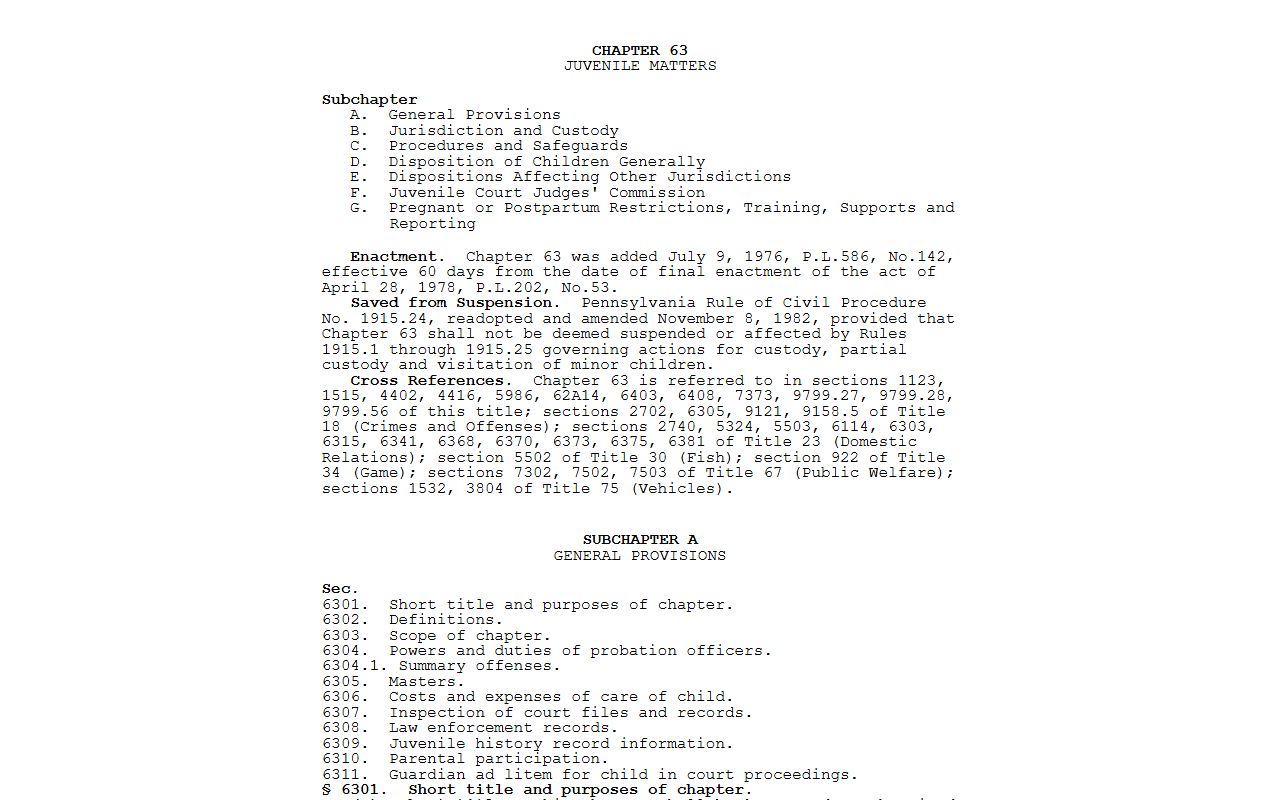
The juvenile-law source supports the page's limit on public juvenile charge and arrest-related records.
Pike County Charge Offices
The Pike County District Attorney's Office is at 506 Broad Street, Milford, PA 18337, phone 570-296-3482, extension 1070. The District Attorney is Raymond Tonkin, and the office email listed in the research is daoffice@pikepa.org. For arrest-to-charges research, the DA role matters because police complaints and arrest-warrant affidavits require Commonwealth attorney approval under Pike's local criminal rule.
The Public Defender's Office is at 102 East John Street, Suite 1, Milford, PA 18337, phone 570-296-5266, extension 1260. Chief Public Defender Eric Hamill is listed with publicdefender@pikepa.org. The adult out-of-jail application must be returned in person by the charged defendant with government-issued identification between 8:30 a.m. and 3:00 p.m., Monday through Friday, and it must be received at least 7 business days before the preliminary hearing.
District Attorney
506 Broad Street
Milford, PA 18337
570-296-3482, ext. 1070
Monday-Friday, 8:30 a.m.-4:30 p.m.
Public Defender
102 East John Street, Suite 1
Milford, PA 18337
570-296-5266, ext. 1260
Applications returned in person by charged defendant
Statewide Charge and History Checks
PATCH is the official Pennsylvania State Police criminal-history background-check system. The UJS portal warns that docket sheets should not be used in place of a criminal-history background check. For employment, licensing, volunteer screening, and other official statewide history needs, use PATCH rather than relying on Pike County arrest records or a court docket alone.
County charge records still matter. They show the local court path, charge changes, warrants, pleas, dismissals, and sentencing details. PATCH matters when the question is a statewide criminal-history report under Pennsylvania law. Both can be correct, but they answer different questions.
Pike County Victim Services
The District Attorney page links to the Children's Advocacy Center and Victim Services. The Children's Advocacy Center page lists 103 West High Street, Milford, PA 18337, phone 570-296-6620, Director of Victim Services Sara Loeb, and email vwcoord@pikepa.org. That office is relevant when charges after arrest involve victim-service coordination, child advocacy, or support resources tied to prosecution.
Note: Victim-service contact details support prosecution-related help, not public lookup of sealed or confidential case files.
The Pike County Children's Advocacy Center and Victim Services page is assigned to this arrest and charge records page.
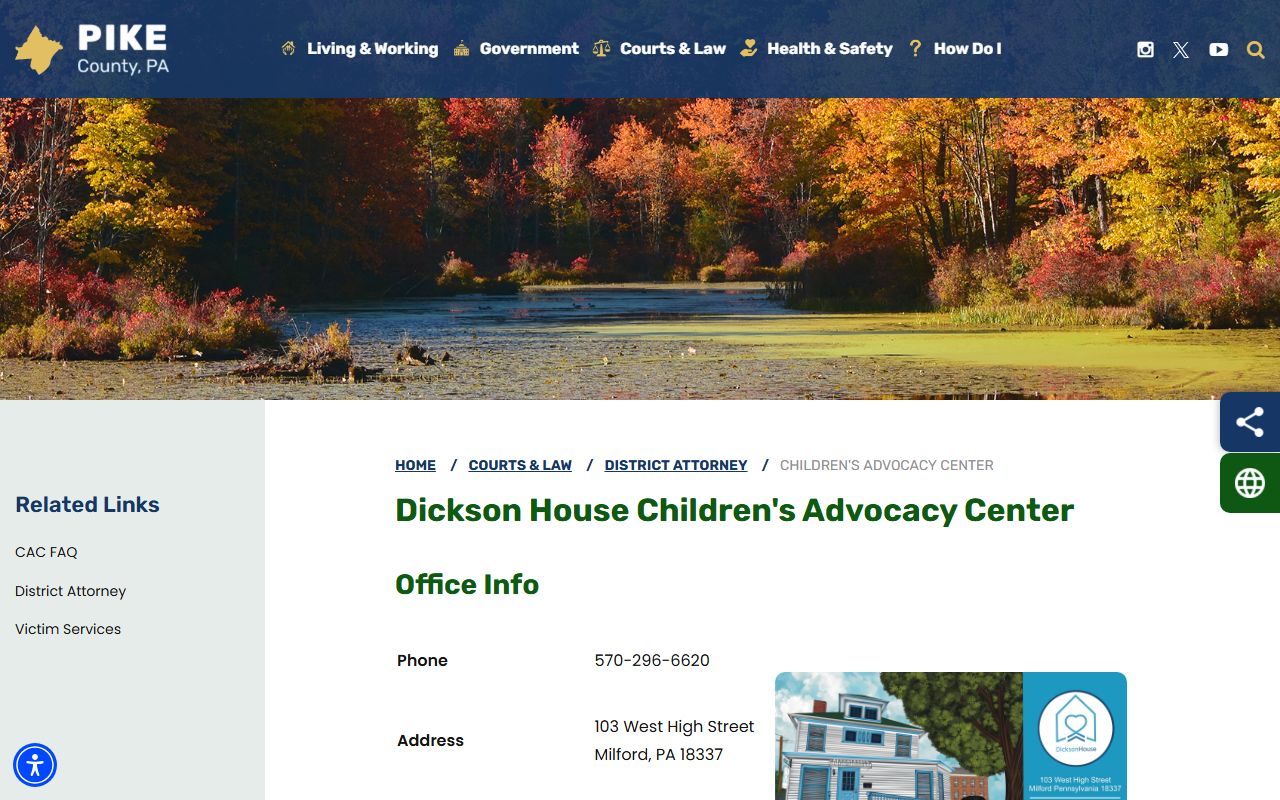
This source belongs with charge records because some criminal cases require victim-service contacts in addition to docket review.
Restricted Pike County Charge Records
Restricted charge records include juvenile matters, dependency files, sealed charges, expunged records, confidential filings, and protected identifying details. Some arrest-related information may also be limited by investigation status, court order, juvenile law, or privacy rules. Public UJS records should be read as the public case view, not as every law-enforcement record tied to an event.
For errors on public docket sheets, the UJS public access policy has a clerical-error process. A party or attorney may submit a written correction request to the applicable custodian. The custodian responds within 10 business days and may need up to 30 additional business days. That process corrects clerical mistakes. It does not change a judge's decision or erase a charge without a proper court order.